


Page 10 - matematica-viii
P. 10
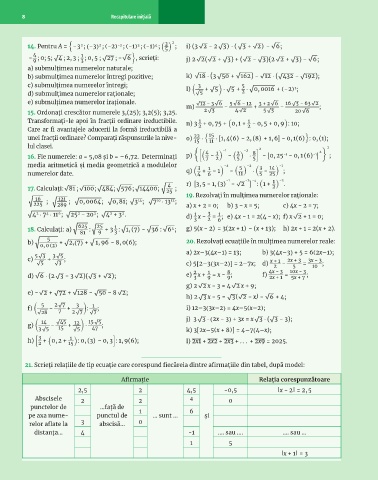
8 Recapitulare inițială
_
_
_
_
_
2
2 _
14. Pentru A = − 3 ; (−3) ; (−2) ; (−1) ; (−1) ; ; i) (3 √ − 2 √ ) ⋅ ( √ + √ ) − √ ;
3
2
3
6
2
−2
2
2
3
4
{
(5)
_ _ _ _ _ _ _ _ _ _ _
4 _
1 _
4
− ; 0; 5; √ ; 2, 3 ; ; 0, 5 ; √ 27 ; − √ , scrieți: j) 2 √ √ + √ 2 3) 2 3) − √ ;
6
2(
2
6
3) + ( √ − √ (2 √ + √
}
3
9
a) submulțimea numerelor naturale; _ _ _ _ _ _
18
12
b) submulțimea numerelor întregi pozitive; k) √ ⋅ (3 √ 50 + √ 162 ) − √ ⋅ ( √ 432 − √ 192 ) ;
_
_
c) submulțimea numerelor întregi; l) + √ ⋅ √ + ⋅ √ 0, 0016 + 3
_
3
5 _
5
(− 2) ;
5
_ _
d) submulțimea numerelor raționale; ( √ 5 ) 2
_
_
_
_
_
_
e) submulțimea numerelor iraționale. m) _ 5 √ − 12 3 + 2 √ 16 √ − 63 √ ;
2
3
6
6
12
√ − 3 √
6
_
_
_
+
−
−
_
_
_
_
2
3
3
6
15. Ordonați crescător numerele 3,(25); 3,2(5); 3,25. 2 √ 4 √ 5 √ 20 √
Transformați-le apoi în fracții ordinare ireductibile. n) 3 + 0, 75 + ( 0, 1 + − 0, 5 + 0, 9 ) : 10 ;
1 _
1 _
Care ar fi avantajele aducerii la formă ireductibilă a 2 2
15
22
_
_
unei fracții ordinare? Comparați răspunsurile la nive- o) ⋅ { ⋅ [1, 4(6) − 2, (8) + 1, 6] − 0, 1(6) } : 0, (1) ;
11
15
lul clasei. −1 −2 2 2
2
8 _
4 _
1 _
2 _
−1
−1
16. Fie numerele: a = 5,08 şi b = –6,72. Determinați p) − − ⋅ − [0, 25 − 0, 1 (6) ] ;
5]
{[(7
}
2)
(5)
media aritmetică şi media geometrică a modulelor 3 _ 1 _ −2 5 _ −2 3 _ 14 −1
_
numerelor date. q) + − 1 − ( ) ⋅ − ;
25)
11
(5
)
(4
6
1 _
−2
−1
_ −2 −1
2
_ _ _ _ _ _ r) [3, 5 − 1, (3) − √ ] : ( 1 + ) .
4 _
81
17. Calculați: √ ; √ 100 ; √ 484 ; √ 576 ; √ 14400 ; ; 2
√ 25
_ _ _ _ _ _ 19. Rezolvați în mulțimea numerelor raționale:
121
16
_ ; _ ; √ 0, 0064 ; √ 0, 81 ; √ 3 ; √ 7 ⋅ 13 ;
10
14
12
√ 225 √ 289
_ _ _ a) x + 2 = 0; b) 3 − x = 5 ; c) 4x − 2 = 7 ;
_
√ 4 ⋅ 7 ⋅ 11 ; √ 25 − 20 ; √ 4 + 3 . d) x − = ; e) 4x − 1 = 2(4 − x) ; f) x √ + 1 = 0 ;
1 _
6
1 _
2
2
2
4
3 _
2
2
2
_ _ _ _ _ 3 2 6
√
25
_
_
1 _
18. Calculați: a) 625 : + 3 : √ 1, (7) − √ 36 : √ 6 ; g) 5(x − 2) = 3(2x + 1) − (x + 13) ; h) 2x + 1 = 2(x + 2) .
4
81
_ _ √ 9 3
_
5
+
b) _ √ 2, (7) + √ 1, 96 − 8, 0(6) ; 20. Rezolvați ecuațiile în mulțimea numerelor reale:
√ 0, 0 (2)
_ _ a) 2x–3 (4x–1) = 13 ; b) 3 (4x–3) + 5 = 6 (2x–1) ;
3
5
5 √
_
c) _ + 3 √ x + 1 2x + 3 3x − 3
;
_
_
_
;
3
5
√ √ c) 5 [2–3 (3x–2) ] = 2–7x ; d) − _ = _
2
10
5
_ _ _ _ _ 2 _ 1 _ 8 _ 4x − 3 _
10x − 3
_
d) √ ⋅ (2 √ − 3 √ ( √ + √ e) x + = x − ; _ f) 2x + 1 = 5x + 7 ;
3
3
2)
6
2) ;
9
3
9
_
2
2
_ _ _ _ _ g) 2 √ x − 3 = 4 √ x + 9 ;
_
2
_
_
e) − √ + √ 72 + √ 128 − √ 50 − 8 √ ; h) 2 √ x − 5 = √ ( √ − x) − √ + 4 ;
2
_
6
3
2
3
_
2 √
3
5
_
1
_
f) − 7 + : ; i) 12–3 (3x–2) = 4x–5 (x–2) ;
_
_ _
_ _
7
7
( √ 28 7 2 √ ) √ _ _ _
_ _ j) 3 √ ⋅ (2x − 3) + 3x = x √ ⋅ ( √ − 3) ;
3
3
3
5
14
12
_
_
g) _ _ − √ 45 _ 15 √
+ ⋅
;
_
5
(3 √ 5 15 √ ) 47 k) 3 [2x–5 (x + 8) ] = 4–7 (4–x) ;
_
_
3 _
1 _
h) + 0, 2 + : 0, (3) − 0, 3 : 1, 9(6) ; l) 2x1 + ‾ + 2x3 + . . . + ‾ = 2025 .
2
2
9
x
x
2
[2
15)
(
]
21. Scrieți relațiile de tip ecuație care corespund fiecăreia dintre afirmațiile din tabel, după model:
Afirmație Relația corespunzătoare
2,5 2 4,5 -0,5 |x − 2| = 2, 5
Abscisele 2 2 4 0
punctelor de ...față de 1 6
pe axa nume- punctul de ... sunt ... şi
relor aflate la 3 abscisă... 0
distanța... 4 -1 .... sau .... .... sau ...
1 5
|x + 1| = 3

